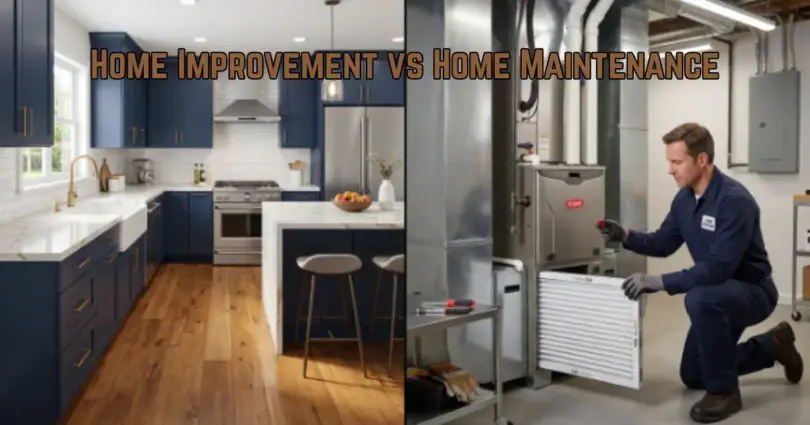

Home improvement vs home maintenance comes down to one simple idea. Maintenance means routine tasks that keep your house working right, like fixing leaks or servicing your HVAC. Improvement means upgrades that add value or change how your home looks, like a kitchen remodel. Maintenance protects what you have. Improvement adds something new. Knowing the difference helps you budget, plan, and even save on taxes.
Confusing home maintenance with home improvement will cost you money. Not eventually. Right now, in ways you probably do not even notice. Fixing a leaky pipe and remodeling a bathroom feel similar on the surface, but they serve completely different purposes, and treating them the same way with your time and your budget is one of the most common mistakes homeowners make.
The truth is, home improvement vs home maintenance is not just about what you are doing to your house. It is about why you are doing it, and that single distinction changes everything from your yearly budget to your tax return.
This guide will walk you through the real difference, the gray areas that trip people up like roof replacements and repainting, and two things almost no other article mentions: how this affects your taxes and your home insurance. You will walk away knowing exactly how to classify any project you are facing.
Think about it this way before you spend another dollar.
What Is Home Maintenance?
Home maintenance is the routine work you do to keep your house running the way it should, nothing more and nothing less.
It is not glamorous. It does not show up on a home tour. But skip it long enough, and everything else in your house starts to fall apart around it.
What Counts as Maintenance
Maintenance covers the small, repeated jobs that keep your home’s systems working properly.
- Servicing your HVAC system every spring and fall
- Cleaning gutters before they clog and overflow
- Checking pipes and faucets for slow leaks
- Sealing gaps around windows and doors
- Testing smoke detectors every few months
- Replacing air filters every one to three months
None of these add anything new to your home. They just keep what you already have working right.
Why Maintenance Is Never Optional
Here is the thing. A lot of homeowners treat maintenance like it is optional, something you get to when you have time.
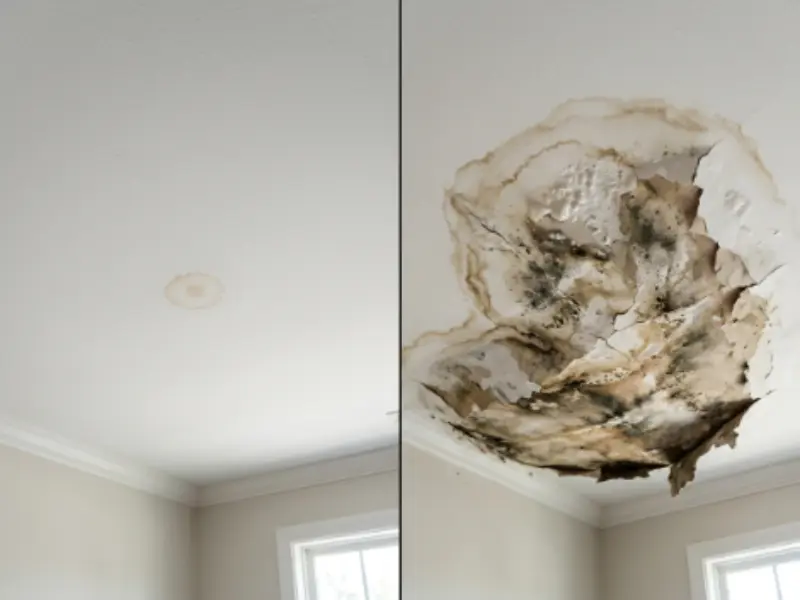
The truth is, skipping maintenance does not save you money. It just moves the cost down the road, usually with interest.
A $200 gutter cleaning ignored for two years can turn into a $4,000 foundation repair. That is not an exaggeration. Water damage from clogged gutters is one of the most common and most preventable repair bills homeowners face.
Think of maintenance as insurance you pay yourself. You are not adding value. You are protecting the value you already earned.
Once you understand what maintenance really is, the next question naturally comes up.
What Is Home Improvement?
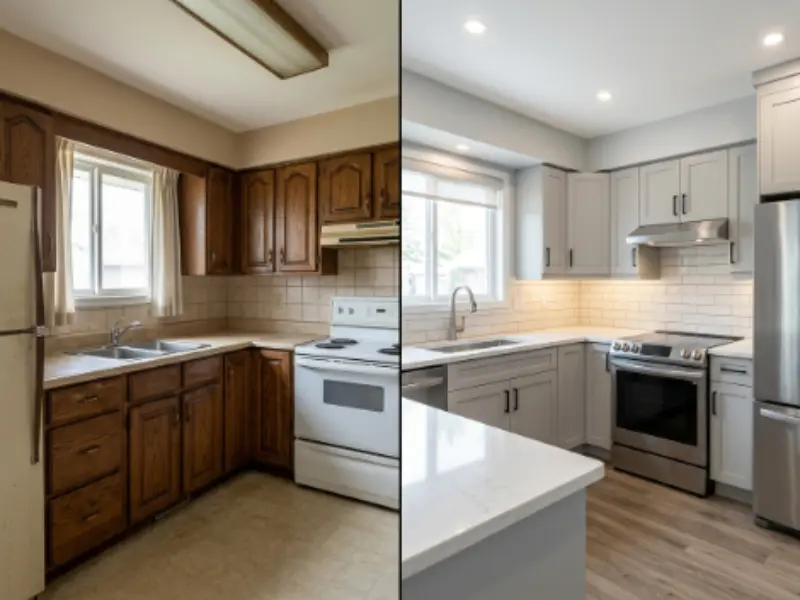
Home improvement is any project you choose to do that adds value, comfort, or style to your home, not because something broke, but because you want more from your space.
This is where the fun stuff lives. Kitchens. Bathrooms. Decks. Smart home upgrades.
Common Home Improvement Projects
These are the projects most homeowners picture when they think of upgrading their house.
- Remodeling a kitchen or bathroom
- Adding a deck, patio, or outdoor living space
- Installing energy-efficient windows
- Finishing a basement into usable living space
- Upgrading landscaping beyond basic lawn care
- Adding smart home technology like thermostats and cameras
Every one of these changes something that was already working fine into something better.
Why People Choose to Improve, Not Just Fix
Home improvement is different from maintenance in one big way. You get to choose the timing.
Nobody wakes up and decides today is the day their pipe bursts. But plenty of people wake up and decide today is the day they finally remodel that outdated kitchen.
From real use, most homeowners who invest in improvements are chasing one of three things: more comfort for themselves, a stronger sale price down the road, or simply catching their home up to modern standards.
Kitchens and bathrooms consistently top every improvement list, and you’ll see the exact return numbers a little later in this guide.
Improvement is the only one of the two where you control the calendar. That single fact is what makes budgeting for it so different from budgeting for maintenance.
Now that you know what each one means on its own, here is where most homeowners actually get confused.
What’s the Real Difference: Home Improvement vs Home Maintenance?
Maintenance protects the value you already have. Improvement adds value you did not have before. That is the entire difference, in one sentence.
Everything else is just details on top of that one idea.
Purpose and Intent
The fastest way to tell them apart is to ask why the project is happening.
- Maintenance happens because something needs to keep working
- Improvement happens because you want something to be better
A leaky faucet gets fixed because it is leaking. That is maintenance. A faucet gets replaced with a fancy touchless model even though the old one worked fine. That is an improvement.
A Simple Test: “Fixing” or “Upgrading”?
Here is a test you can run on literally any home project in five seconds: would you still do this if nothing was broken?
If the answer is yes, it is an improvement. If the answer is no, it is maintenance.
This one question clears up almost every confusing case homeowners run into, and it is something no other guide on this topic gives you.
| Home Maintenance | Home Improvement | |
| Purpose | Keep things working | Make things better |
| Timing | Often urgent | Usually your choice |
| Cost pattern | Small, repeated | Large, one-time |
| Effect on value | Protects existing value | Adds new value |
| Example | Fixing a leak | Remodeling a bathroom |
| Tax treatment | Rarely deductible | Can raise cost basis |
In practice, most homeowners deal with both at the same time, and that is exactly where budgeting gets messy if you do not know which bucket a project belongs in.
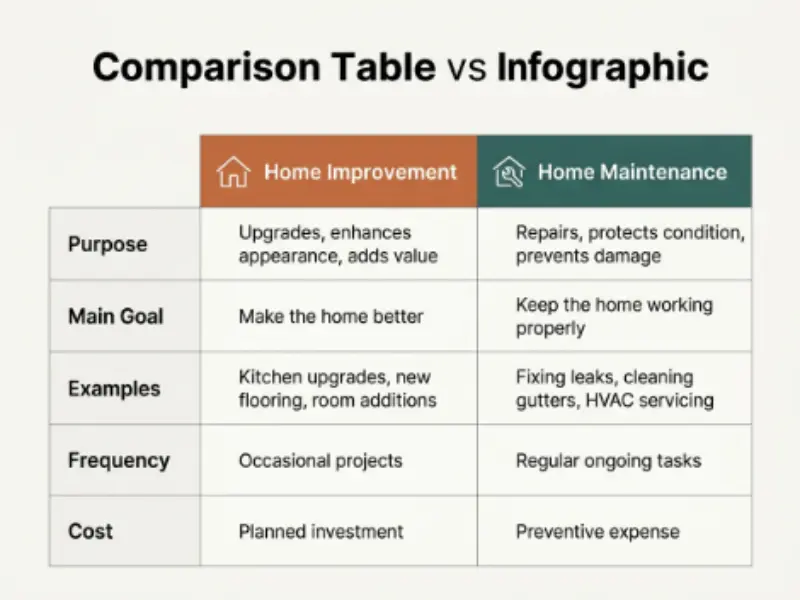
Once you can sort any project into one of these two buckets, the next question is where things start to get genuinely tricky.
Is Replacing a Roof Maintenance or Improvement?
It depends on why you are doing it. Fixing storm damage on your roof is maintenance. Replacing an old roof to upgrade materials or boost your home’s value is an improvement.
This is where most homeowners get stuck, and it is exactly what none of the top-ranking articles on this topic actually explain.
When a Repair Becomes an Upgrade
The line gets blurry fast. Here is how to tell which side of the line you are on.
- Storm knocked off shingles, you replace them: maintenance
- Roof is fine, but you switch to premium metal for looks: improvement
- Old roof is failing everywhere, you replace it entirely: often a mix of both
When a project is a mix of both, split it in your head. The part that restores function is maintenance. The part that upgrades materials beyond what you had is improvement. This matters for your budget and your taxes, which we cover next.
5 Tricky Examples Homeowners Get Wrong
Use this list any time you are not sure which bucket a project belongs in.
- Water heater dies, you replace with the same model: maintenance
- Water heater still works, you replace with a tankless system: improvement
- You repaint a faded wall the same color: maintenance
- You repaint to change your home’s whole look before selling: improvement
- You replace cracked driveway concrete with the same material: maintenance
- You replace it with pavers for a nicer look: improvement
- Old windows are drafty, you replace with the same type: maintenance
- You upgrade to energy-efficient windows: improvement
- Carpet is worn out, you replace with the same carpet: maintenance
- You rip out carpet for hardwood floors: improvement
In practice, the test from earlier works perfectly here too. Would you have done this if nothing was broken? If yes, it is an improvement, even if a repair started the conversation.
This gray-area confusion is exactly why so many homeowners misjudge their own project costs, and it carries a real financial consequence you probably have not thought about.
How Do Maintenance and Improvement Affect Your Taxes?
Repairs and maintenance on your primary home are rarely tax-deductible. Improvements, on the other hand, can raise what the IRS calls your home’s cost basis, which can lower your taxes when you sell.
This is the part every other article on this topic skips completely, and it is one of the most useful things you can walk away knowing.
What the IRS Considers a “Repair”
The IRS has a clear rule here. A repair keeps your home in ordinary working condition. It does not add value or extend your home’s life.
- Fixing a leak
- Patching drywall
- Repainting a room
- Replacing a broken windowpane
None of these count toward lowering your taxes when you sell your home.
What Counts as a “Capital Improvement”
A capital improvement is different. It adds value, extends your home’s life, or adapts it for new use.
- Adding a deck or new room
- A full kitchen renovation
- Installing central air where there was none
- Adding a bathroom
These get added to your home’s cost basis. That means when you sell, you subtract this cost basis from your sale price, which can lower the profit you get taxed on.
Here is the math nobody explains simply. Say you bought your home for $300,000 and spent $40,000 on a kitchen remodel. Your new cost basis becomes $340,000. If you sell for $450,000, you are taxed on $110,000 of profit instead of $150,000. That is real money saved, just for keeping receipts.
Rental Property Difference
If you rent out your home or a room in it, the rules flip a little.
- Repairs on a rental are usually deductible the same year
- Improvements still get added to cost basis, not deducted right away
From real use, this is exactly why keeping a simple folder of every home project receipt pays off, whether it is a maintenance job or a full renovation.
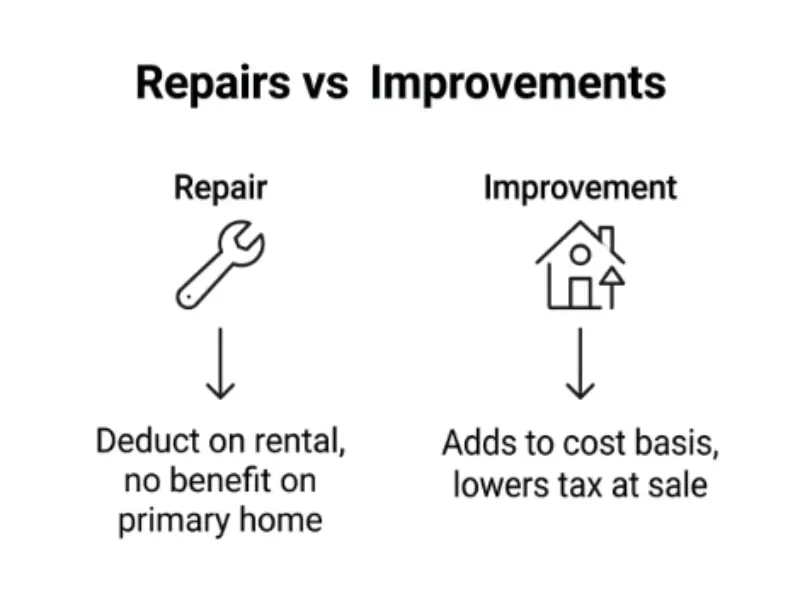
Once you know how the tax side works, the next natural question is how much you should actually be setting aside for each one every year.
How Much Should You Budget for Maintenance vs. Improvement?
Set aside 1 to 3 percent of your home’s value every year for maintenance. Budget improvements separately, based on the specific project you are planning.
These two numbers should never live in the same budget line, and treating them separately is the single biggest fix most homeowners need.
A Simple Yearly Maintenance Budget Formula
Here is a formula you can use right now, no spreadsheet needed.
- Take your home’s current value
- Multiply it by 0.02 for a middle-ground estimate
- That number is your yearly maintenance budget
For a $350,000 home, that comes out to $7,000 a year. Spread across 12 months, that is under $600 a month for HVAC servicing, gutter cleaning, small repairs, and inspections.
Realistic Costs for Popular Improvements
Improvement costs vary a lot more, since they depend entirely on what you choose to do.
- Minor kitchen remodel: $15,000 to $30,000
- Bathroom remodel: $10,000 to $25,000
- New energy-efficient windows: $8,000 to $20,000, can cut energy bills by 15 percent or more
- Deck addition: $5,000 to $15,000
- Basement finishing: $20,000 to $50,000
Here is something worth sitting with. That same $350,000 home needs roughly $7,000 a year just to stay where it is. A single kitchen remodel can cost four times your entire annual maintenance budget. That is exactly why skipping maintenance to save for an upgrade almost always backfires, a point we will come back to shortly.
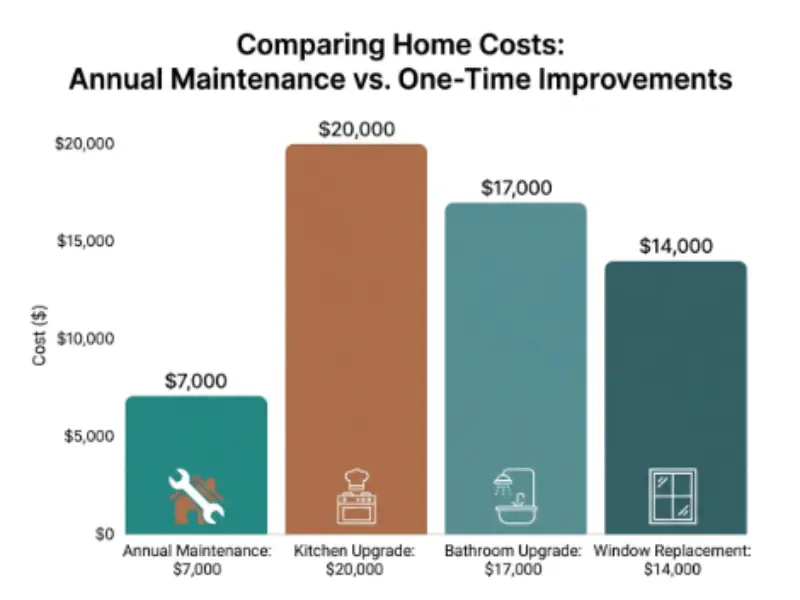
Now that you have real numbers to work with, the next question is which one deserves your money first when you cannot do both at once.
Which Should You Do First: Maintain or Improve?
Always fix what is broken before you upgrade what is not. Skipping maintenance to chase an upgrade almost always costs you more in the end.
This sounds obvious on paper, but in practice, it is the single most common mistake homeowners make with their budget.
The Order That Actually Protects Your Money
Here’s how it works. Your house sends you signals about what needs attention first.
- Safety and structural issues come first, always
- Function comes second, things like plumbing or HVAC
- Cosmetic fixes come third, paint, small repairs
- Upgrades and improvements come last
Most guides on this topic only talk about this order in the context of selling a house. That is too narrow. This order matters just as much if you are staying in your home for the next 20 years, because a small maintenance issue left behind an upgrade only gets more expensive to fix later.
A Homeowner Example: The $25,000 Kitchen Mistake
Here is a real pattern seen constantly in the industry. A homeowner spends $25,000 on a gourmet kitchen remodel. Six months later, the roof starts leaking, and it turns out it needed replacing before the remodel even started.
Now they are paying for a new roof on top of the kitchen, and the water damage from the leak has stained the new cabinets they just installed.
What actually works is simple: get a basic home inspection before you commit to any big improvement. It costs a few hundred dollars and can save you from a five-figure mistake.
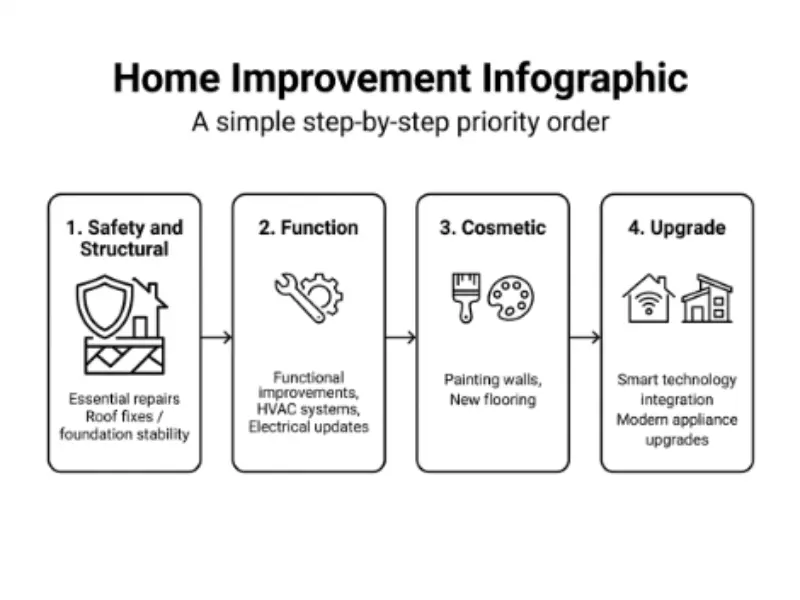
Getting the order right protects your money. But there is another risk tied to skipped maintenance that almost nobody warns you about.
Does Skipping Maintenance Affect Your Home Insurance or Warranty?
Yes. Insurers can deny claims tied to a lack of maintenance, and most home warranties will not cover damage caused by neglect either.
This is a section you will not find in any competing article on this topic, and it carries real financial weight.
What Insurers Actually Look For After a Claim
When you file a claim, your insurer investigates what caused the damage. If they find a maintenance issue behind it, they can refuse to pay.
- A roof leak from years of missed inspections: often denied
- A pipe burst from age and neglect: often denied
- Storm damage on a well-maintained roof: usually covered
In practice, insurance is built to cover sudden, unexpected damage, not damage that built up slowly because upkeep was ignored.
Home Warranty vs. Insurance: Quick Clarification
These two get confused constantly, so here is the simple version.
- Home insurance covers sudden damage, like fire, storms, or theft
- A home warranty covers the cost to repair or replace specific systems and appliances that fail from normal wear
Here is the catch nobody explains. A home warranty sounds like it covers everything, but most contracts have a clause excluding damage from “lack of maintenance.” So if your HVAC dies because you never changed the filter, the warranty company can point to that exact reason and deny your claim.
Skipping small maintenance tasks does not just cost you in repairs. It can leave you paying full price out of pocket right when you expect to be covered.
Knowing the difference here does more than help your budget. It protects you legally too, in ways most homeowners never think about until they need it. Now, let’s look at which improvements are actually worth your money.
What Improvements Actually Add the Most Value?
Kitchen and bathroom updates, energy-efficient windows, and curb appeal projects consistently return the most value at resale.
Not every upgrade pays you back the same way, and knowing which ones do saves you from spending on the wrong thing.
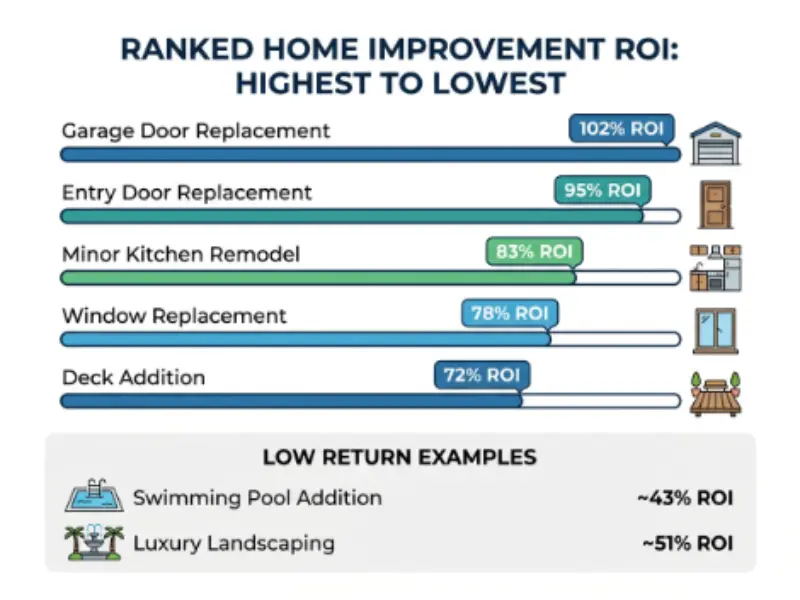
Best ROI Projects Ranked
Here is how the most popular improvements actually perform, based on typical resale returns.
- Minor kitchen remodel: returns 70 to 80 percent of cost
- Garage door replacement: returns close to 90 percent, one of the highest returns available
- Energy-efficient window replacement: returns 65 to 75 percent, plus lower energy bills
- New siding: returns around 70 to 80 percent
- Bathroom remodel: returns 60 to 70 percent
Improvements That Feel Nice But Don’t Pay Back
Almost every competitor article only lists the winners. Nobody tells you what to skip. Here is the honest list of upgrades that feel great to live with but rarely pay you back at resale.
- Swimming pools, often return less than 50 percent, sometimes scare off buyers entirely
- High-end luxury landscaping, most buyers will not pay extra for it
- Overly personalized rooms, like a home theater or wine cellar
- Sunrooms, they cost a lot and appeal to a narrow group of buyers
From real use, the smartest approach is simple. If you are improving your home to sell soon, stick to the top of this list. If you are staying long term, the bottom list is completely fine to enjoy, just do not expect it back at resale.
Now you know exactly what maintenance means, what improvement means, and how to spend your money wisely on both.
Frequently Asked Questions
What is the difference between a home repair and a home improvement?
A repair fixes something that broke, like a leaky pipe or a cracked window. An improvement upgrades something that was already working, like remodeling a kitchen with no problems. Repairs restored. Improvements add value or comfort you did not have before. The purpose behind the project decides which one it is.
Is painting your house maintenance or improvement?
It depends on why you are painting. Repainting a faded wall the same color to keep it looking fresh counts as maintenance. Changing the color entirely to update your home’s style or boost resale appeal counts as improvement. Same task, different intent, different answer.
How much should I budget for home maintenance every year?
Set aside 1 to 3 percent of your home’s value each year for maintenance. For a $350,000 home, that comes out to roughly $3,500 to $10,500 annually. This covers HVAC servicing, gutter cleaning, small repairs, and regular inspections that keep bigger problems from developing.
Do home improvements increase your property taxes?
Yes, often they do. Local tax assessors reassess your home’s value after major improvements like additions or full renovations, which can raise your property tax bill. Small maintenance work like fixing a leak or repainting typically does not trigger a reassessment at all.
Are home improvements tax deductible?
Not usually in the year you make them. Instead, improvements raise your home’s cost basis, which can lower the taxable profit when you sell. Repairs on your primary home are rarely deductible at all, though repairs on a rental property often are, in the same year you pay for them.
What home improvements add the most resale value?
Garage door replacement returns close to 90 percent of its cost, one of the highest returns available. Minor kitchen remodels return 70 to 80 percent, and energy-efficient windows return 65 to 75 percent while also lowering your utility bills every month you own the home.
Can skipping maintenance void my home warranty?
Yes. Most home warranty contracts include a clause that excludes damage caused by lack of maintenance. If an HVAC system fails because filters were never changed, the warranty company can point to that neglect and deny your claim, leaving you paying full repair costs yourself.
Is replacing a water heater a repair or an upgrade?
If your water heater breaks and you replace it with the same type, that is a repair. If it still works fine and you upgrade to a tankless system for efficiency or space, that is an improvement. The condition of the old unit decides the answer.
Should I maintain my home before improving it?
Yes, always. Fix safety and structural issues first, then function, then cosmetic details, and save upgrades for last. Skipping maintenance to fund an upgrade often backfires, since a small ignored problem like a roof leak can damage a brand new remodel sitting right beneath it.
What’s a simple way to tell maintenance from improvement?
Ask yourself one question: would I still do this if nothing was broken? If yes, it is an improvement. If not, it is maintenance. This quick test works on almost any home project, from a leaky faucet to a full kitchen remodel, no guesswork needed.
Conclusion
You now have everything you need to tell home improvement vs home maintenance apart, even in the confusing cases that trip up most homeowners. Maintenance protects the value you already have. Improvement adds new value on your terms. Remember to fix safety and structural issues before chasing upgrades, since skipping that order is how a $25,000 kitchen remodel ends up damaged by a roof that should have been fixed first.
Before your next home project, run it through the simple test: would you still do this if nothing was broken? That single question will tell you exactly which bucket it belongs in, and how to budget for it properly. Take a look at your own home right now. Is there a small maintenance task you have been putting off? Handle that first, then plan your next upgrade with a clear head and a clear budget. Your future self will be glad you did.