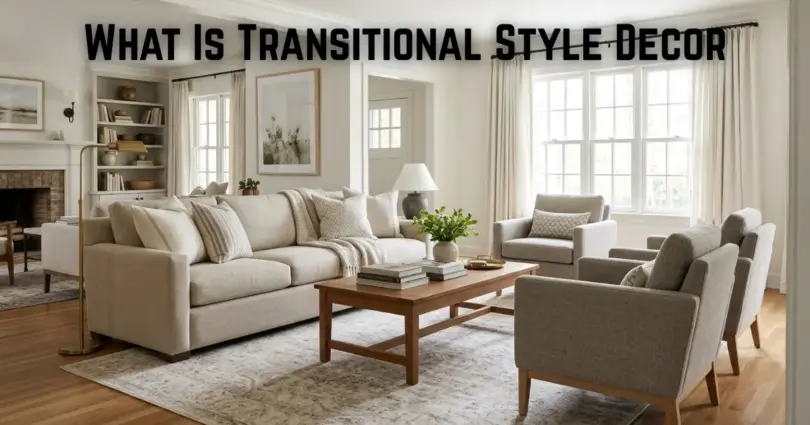

What is transitional style decor? It is a design style that mixes traditional and modern looks in one calm, comfortable space. Think soft neutral colors, clean lines, and cozy textures like linen and wool. You pair classic shapes, like a rolled-arm sofa, with simple modern pieces, like a sleek lamp. The goal is balance, so the room feels timeless and easy to live in.
You love your old wooden dresser. You also love the clean, simple look of new furniture. So you stand in the store, stuck, because picking one feels like losing the other.
Sound familiar? Then you may have typed this into Google: “what is transitional style decor?”
Here is the good news. We know how hard this can be, but the answer is simpler than it sounds. Transitional style decor lets you keep what you love from both sides, and the room still feels planned, not random.
This guide shows you how to build it, step by step. You’ll learn how to tell if your room is already close, how to tell this style apart from look-alikes, and how to fix a room that feels flat.
By the end, mixing old and new will feel easy, not scary. You’ll also get room-by-room ideas, including kitchens and bathrooms, plus the mistakes that are easy to make.
Let’s start by getting clear on what this style really is.
What Is Transitional Style Decor?
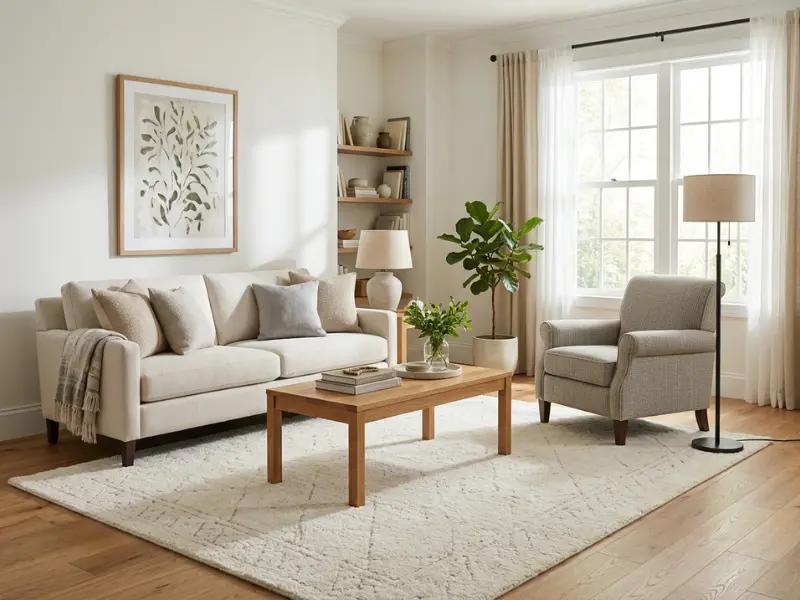
Transitional style decor is a middle path between old and new. It keeps the comfort and classic shapes of traditional rooms, and it drops the heavy decoration.
Below, you’ll see what the word really means, how to spot the look in a room, and where it came from.
What Does “Transitional” Actually Mean?
The word means “in between.” One end is traditional design, with carved wood and formal fabrics. The other end is modern design, with straight lines and bare surfaces. Transitional stands in the middle.
Here is the thing: it’s not a 50/50 mash. Old and new pieces share the same soft colors, so they look like they belong together.
For example, picture a classic wingback chair next to a plain wood coffee table with thin metal legs. Different eras. Same colors. Same calm feel.
6 Signs a Room Is Transitional
Use this quick check on your own room. Give yourself one point for each sign:
- Soft neutral walls and big pieces, like cream, greige, or warm white
- Clean lines on most furniture, with a few gentle curves
- At least one classic piece and one modern piece in the same room
- Layers of texture, like linen, wool, wood, or leather
- Simple accessories, with empty space on shelves and tables
- Seating that looks calm and feels comfy
As a rough guide, 4 or more points means your room is already close. Fewer than that? The sections below show you how to fill the gaps.
Nothing shouts. Your eye moves around the room, not to one loud piece.
A Quick Look at Where the Style Came From
The style first became popular in the mid-2000s, when designers blended traditional looks with modern elements. That mix gave people the warmth of old rooms with the calm of new ones.
Now you know what the style is. The next question is a big one: how is it different from traditional, modern, and contemporary?
How Is Transitional Style Different From Traditional, Modern, and Contemporary?
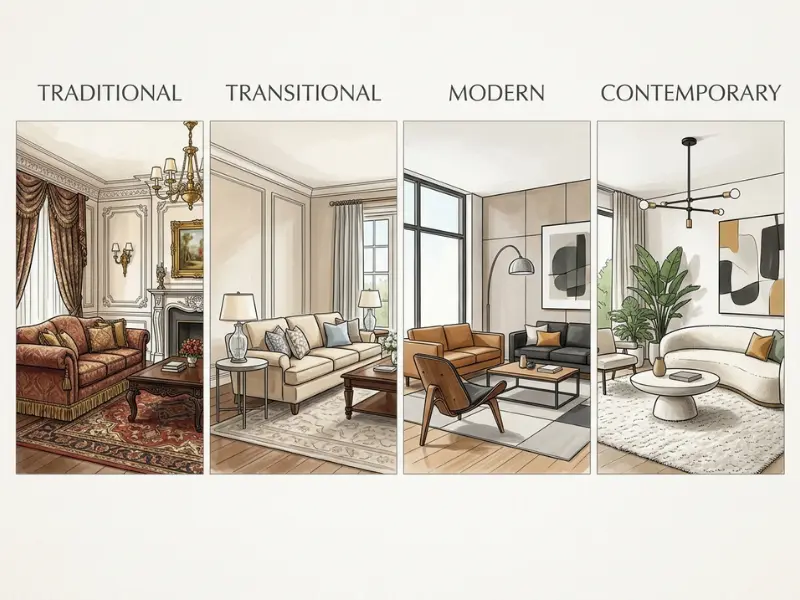
Transitional sits in the middle. Traditional is formal and fancy, modern is sleek and minimal, and transitional takes the comfort of the first and the calm of the second.
Here is a quick table, then a closer look at each pair. You’ll also see how to tell it apart from look-alike styles.
| Style | Mood | Colors | Furniture | Patterns |
| Traditional | Formal and rich | Deeper, warmer tones | Carved, heavy, dark wood | Many and detailed |
| Transitional | Calm and cozy | Soft neutrals | Simple shapes, a few curves | Few and quiet |
| Modern | Sleek and bare | Black, white, gray | Straight lines, little decor | Almost none |
| Contemporary | Fresh and current | Neutrals that shift with trends | Whatever is popular now | Varies |
Transitional vs Traditional
Traditional rooms are formal, with carved details, many patterns, and dark woods. Transitional keeps the comfy seating but uses fewer patterns, lighter woods, and calmer colors.
Think of it as traditional with the volume turned down.
Transitional vs Modern
Modern rooms are sleek and minimal, and they can feel cold. Transitional keeps the clean lines but adds warm textures, soft fabrics, and a few curves, so people actually want to sit down.
Transitional vs Contemporary (and Why “Modern” and “Contemporary” Are Not the Same Thing)
Modern points to a design movement from the early to mid 1900s. Contemporary just means what’s popular right now, so it changes over the years. Transitional changes slowly because it doesn’t belong to one era.
Look-Alikes People Confuse With It (Modern Farmhouse, Mid-Century)
Modern farmhouse leans on rustic wood, shiplap, and black metal accents. Mid-century modern leans on tapered legs, teak, and bold pops of color.
Try the theme test. If you can name a place or an era for the room, like a barn or the 1960s, it’s not transitional. Transitional rooms have no theme. They only have a mood.
Now that you can tell the styles apart, color is the next thing to get right, because it holds the whole look together.
What Colors Work Best in Transitional Decor?
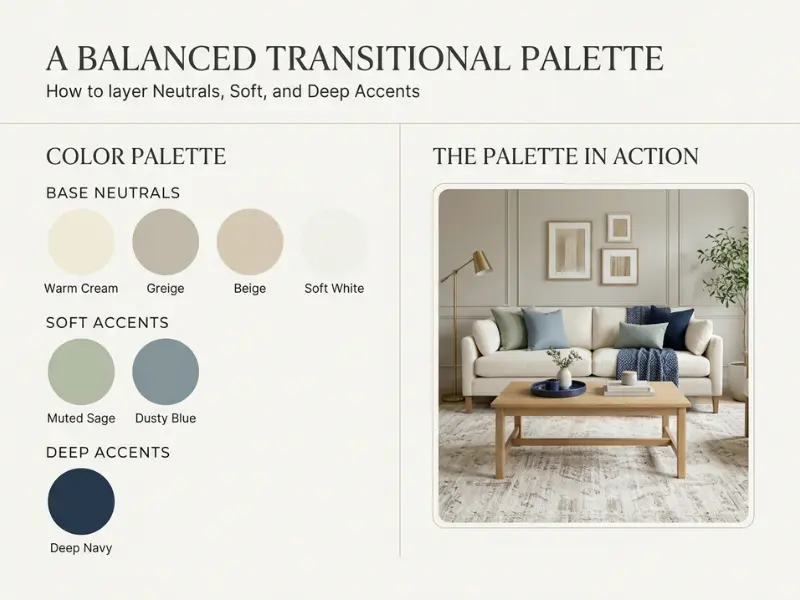
In transitional style decor, soft neutrals work best: cream, beige, greige, taupe, and warm white. Add a muted blue or green for a little life.
You’ll get a simple transitional color palette: a base, two layers of accents, and a formula you can copy.
The Neutral Base (Greige, Taupe, Cream, Warm White)
Neutrals let old and new pieces sit together without a fight. A common pairing is taupe, tan, and vanilla with a touch of dark brown for depth.
- Cream and warm white work well for walls and trim
- Greige and taupe suit sofas and curtains
- Dark brown or charcoal works for small anchors, like frames and table legs
Here is a small tip that matters a lot: check the undertone. Greige and taupe lean warm (a little yellow or pink) or cool (a little blue or gray).
Hold each swatch next to plain white paper in your room’s light, then stick to one undertone.
Soft Accent Colors (Muted Blue, Sage, Seafoam)
Pale blue, aqua, sage, and seafoam add calm life without shouting. Denim blue pillows or a sage throw are easy places to start.
Deep Accents, Used Sparingly (Navy, Emerald)
Navy and emerald add drama, so use them in small doses. A vase, a lamp base, or one chair is plenty. Warm metals like brass or bronze add a soft shine on top.
A Simple Color Formula for Beginners (One Base Neutral Plus One or Two Accents)
Pick one base neutral family, one or two soft accents, and one small deep accent. For example: cream walls, a greige sofa, a sage pillow, and a navy vase.
As a rough guide, let the neutral cover most of the room and keep the deep accent to one or two small things.
Once your colors are picked, the next question is easy: what will you sit on?
What Furniture Fits This Style?
Simple shapes and a comfy feel fit best. Mix straight lines with a few curves, and soft fabrics with wood or metal frames.
You’ll see how to pick transitional furniture: sofas and chairs, frames and fabrics, and one old piece for a modern room.
Sofas and Chairs (Rounded Plus Straight Silhouettes)
Let straight and round shapes share the room. A boxy sectional looks great beside a round side table or a curvy armchair. Each shape softens the other.
The truth is, comfort comes first in transitional style decor. Aim for seating that’s roomy but not stiff. Deep seats and generous cushions tell guests to sit down.
Keep the big pieces simple and put the character in the small ones. Buy a plain sofa, then let chairs, pillows, and side tables carry your personality. Swapping a pillow costs far less than swapping a sofa.
Wood and Metal Legs and Frames
Frames tie the mix together. Wood adds warmth. Metal adds a clean edge.
- Oak or maple frames suit most rooms
- Thin metal legs make heavy pieces look lighter
- Nailhead trim and turned legs add a classic touch to a plain shape
Try a wood coffee table beside a metal side table. Two materials, one calm look.
Upholstery That Works (Linen, Velvet, Chenille, Leather)
- Linen gives a relaxed, airy feel
- Velvet adds a soft, rich touch
- Chenille feels cozy on sleek wood frames
- Leather brings a polished, tailored look
Want pattern? Keep it quiet, or save it for your pillows.
How to Mix One Vintage or Antique Piece Into a Modern Room
Start with just one. An old armchair makes a fine accent chair. A vintage dresser can hold your TV.
The easiest link is matching its wood tone to one new item, like a picture frame or a table leg. That small match makes the old piece look planned, not lost.
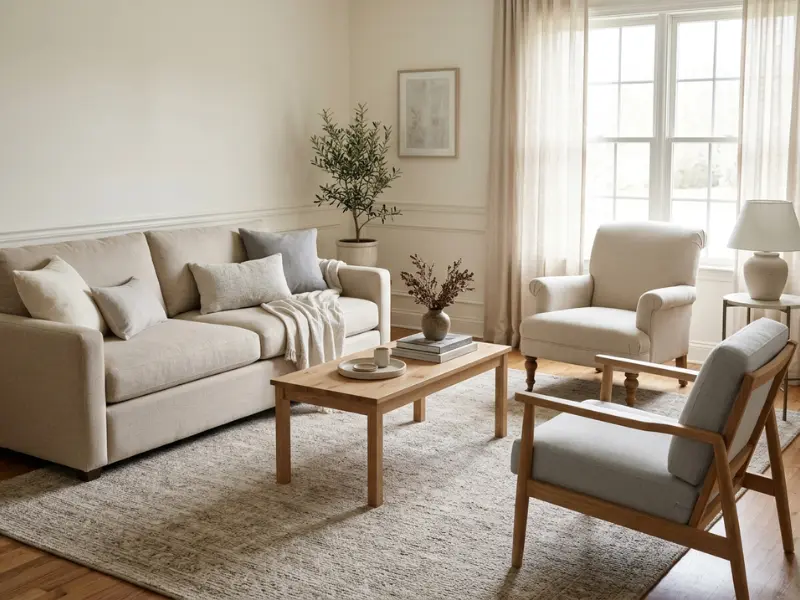
A sofa can look right and still feel wrong. The fix is in the materials.
Which Textures and Materials Matter Most?
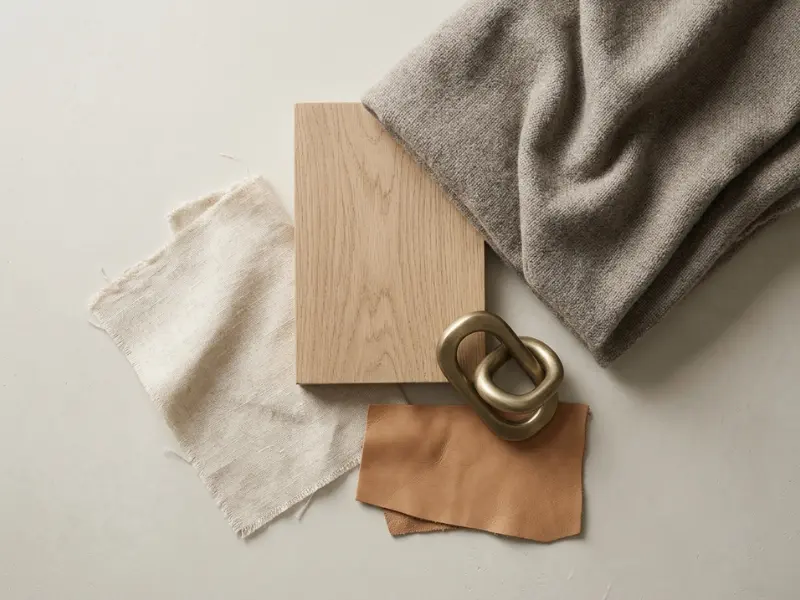
Natural materials work best: wood, stone, linen, wool, and leather. In a neutral room, texture does the job that color usually does.
You’ll see which natural materials to pick, how to layer fabrics, and which metal finishes work.
Natural Materials (Wood, Stone, Marble)
Light woods like oak and maple add warmth. Stone like marble, travertine, and granite adds a smooth, cool touch. Think of a marble fireplace or a stone tile backsplash.
Natural materials look calm on their own, so they keep your mix of old and new from feeling busy.
Fabrics and How to Layer Them in a Neutral Room
Pair soft with smooth. Drape a nubby wool throw over a velvet sofa. Set a leather ottoman near a linen chair. Put a sheepskin on a seat for extra softness.
Here is the beige trap fix. Use at least 3 or 4 different textures in one neutral room, like a linen sofa, a wool rug, a wood table, and a brass lamp.
Then try the touch test: if everything feels the same under your hand, the room will look flat.
Metal Finishes (Brass, Bronze, Nickel, Chrome)
Warm finishes like unlacquered brass, oil-rubbed bronze, and antique nickel feel refined and relaxed. Chrome and silver give a cooler, brighter shine.
A simple rule is to pick one or two finishes per room and repeat each one at least twice. For example, use brass on a lamp and a drawer pull, and nickel on a frame and a vase.
Great textures still look flat in bad light, so lighting comes next.
How Do You Choose the Right Lighting?
Mix lights from both worlds. Put one modern fixture in a classic room, and layer ceiling, table, floor, and wall lights.
You’ll see how to use one surprise fixture, how to layer light, and which finishes suit transitional lighting.
One Modern Light in a Traditional Room (the Surprise Piece)
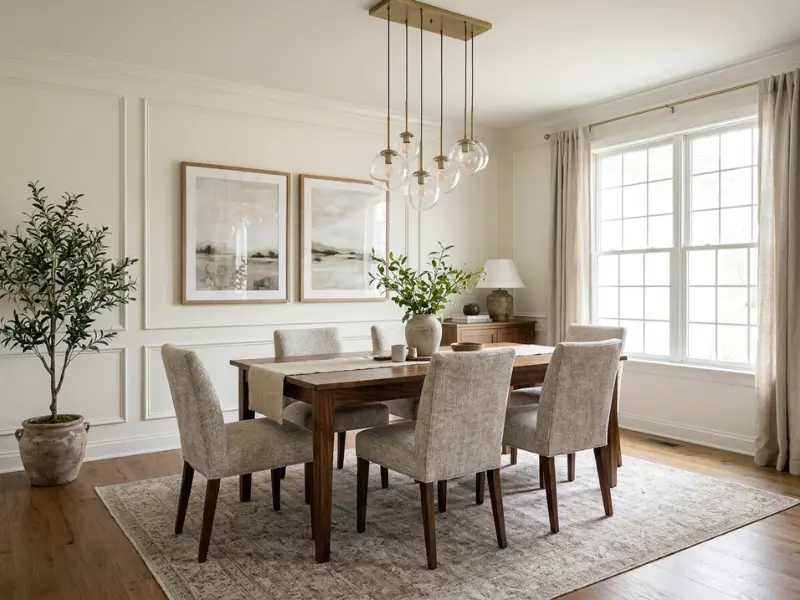
Picture a classic dining room with a carved sideboard, tufted chairs, and soft molding. Now hang a bold, modern multi-pendant chandelier over the table. Your eye lands right on it.
That’s the idea. You can flip it too: a grand classic chandelier in a plain modern room works just as well.
Try one surprise piece per room. Pick one fixture to be the bold one, and keep the rest of the room quiet. Two bold lights fight. One looks planned.
Layering Ambient and Task Lighting
Use four layers so every corner of your room works:
- Ceiling lights set the mood for the whole room
- Table lamps light bedsides and side tables
- Floor lamps cover reading corners
- Wall sconces add a soft glow along the walls
Pick warm white bulbs, around 2700K, for a cozy feel.
Best Finishes for Fixtures
Brass, bronze, nickel, and aged silver all suit transitional style decor. Match each finish to something else in the room, like a cabinet pull or a picture frame.
Now the room has its bones and its glow. The small things on top are what finish it.
How Do You Add Accessories, Art, and Plants Without Clutter?
Choose fewer, bigger, more meaningful pieces. Group items in threes, leave empty space, and add one or two plants.
You’ll learn what to keep on your shelves, how to use art and mirrors as focal points, and which plants are hard to kill.
Minimal Accessories (What to Keep, What to Skip)
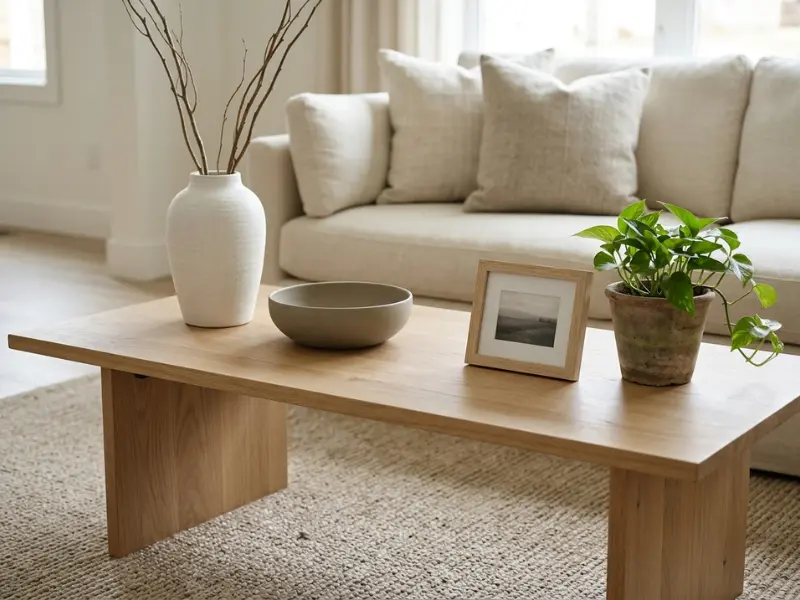
A few well-chosen things beat a full shelf. A small potted succulent, a photo in a silver frame, and one good vase can say plenty.
Keep:
- Pieces with a story, like a family photo or a travel find
- Soft, neutral colors that match your base
- Simple shapes, like a plain ceramic bowl
Skip:
- Rows of tiny figurines
- Matching sets of everything
- Items with no job and no story
Try the edit test. Take one item off every shelf and table, then put back only what you miss. Group what’s left in threes with different heights, like a tall vase, a low bowl, and a small frame.
Art and Mirrors as Focal Points
Pick one big piece instead of ten small ones. A large mirror bounces light around and makes a small room feel bigger. A pair of mirrors on each side of a fireplace does the same job.
Black and white prints keep walls calm. For an easy gallery wall, lean art on floating shelves. White or silver frames stand out nicely against a gray wall.
As a rough guide, hang art so its center sits about 57 inches from the floor.
Easy Plants for This Look (Snake Plant, Rubber Tree, Philodendron)
Snake plants, rubber trees, and philodendrons are easy to care for.
Hide plastic pots in a woven basket for extra texture. Fill a bedside vase with a few eucalyptus stems. One or two plants per room is plenty.
A classic urn holding a simple modern plant works well.
Surfaces are done. Now look down and sideways: your rugs, curtains, and floors.
What About Rugs, Curtains, and Floors?
Pick soft, simple, neutral pieces. Use a plain or patterned rug, layered curtains, and floors that flow from room to room.
You’ll see how rugs add warmth, how to mix curtains with blinds, and how to keep floors consistent.
Rugs That Add Warmth and Define Zones
A rug warms up hardwood and marks out a space in an open room. In a living room, it ties the seating together. As a rough guide, the front legs of your sofa and chairs should sit on it.
Plain and striped rugs work well. Geometric patterns do too.
Here is the thing about patterned rooms. If your walls, curtains, or pillows already carry a pattern, pick a tone-on-tone rug.
If your room is plain, a geometric rug can be the one bold pattern. Keep to one lead pattern per area.
Curtains, Sheers, and Blinds Together
Mix them. Drapes give privacy and softness. Blinds give you light control.
- Sheers soften harsh sun and keep privacy
- Roller shades tuck into a valance for a clean look
- Woven roman shades and wood shutters add texture
- Velvet drapes add a rich, soft finish
Flooring That Flows From Room to Room
Use one main floor through connected rooms. Wide-plank oak or neutral tile ties spaces together. Porcelain tile suits kitchens and bathrooms, and herringbone stone tile makes a strong entryway.
A sisal rug adds natural texture on top. Change the feel of a room with rugs, not with new flooring.
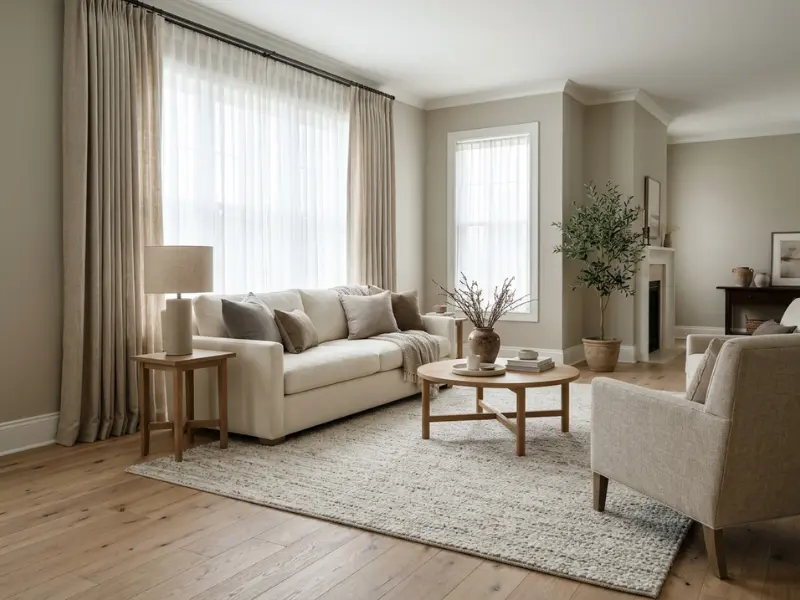
You now have every piece of the puzzle. Here is how they fit together, one room at a time.
How Do You Get the Transitional Look in Each Room?
Use the same recipe in every room: a neutral base, one classic piece, one modern piece, and soft texture. Only the main items change.
Below, you’ll get picks for your living room, bedroom, kitchen, bathroom, and dining room.
Living Room
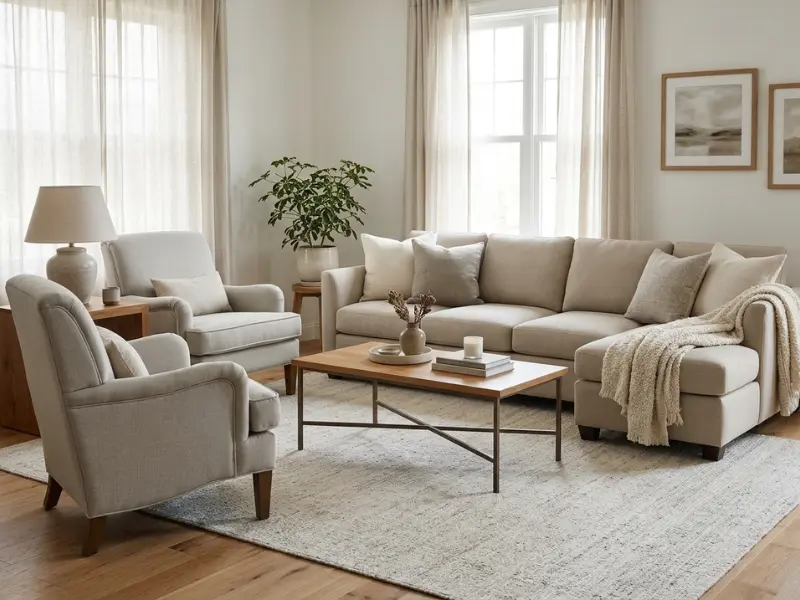
For a transitional living room, start with a roomy sofa or sectional in a neutral fabric. Add one classic piece, like a rolled-arm chair. Add one modern piece, like a coffee table with metal legs.
Finish with a wool throw and one large mirror.
Bedroom
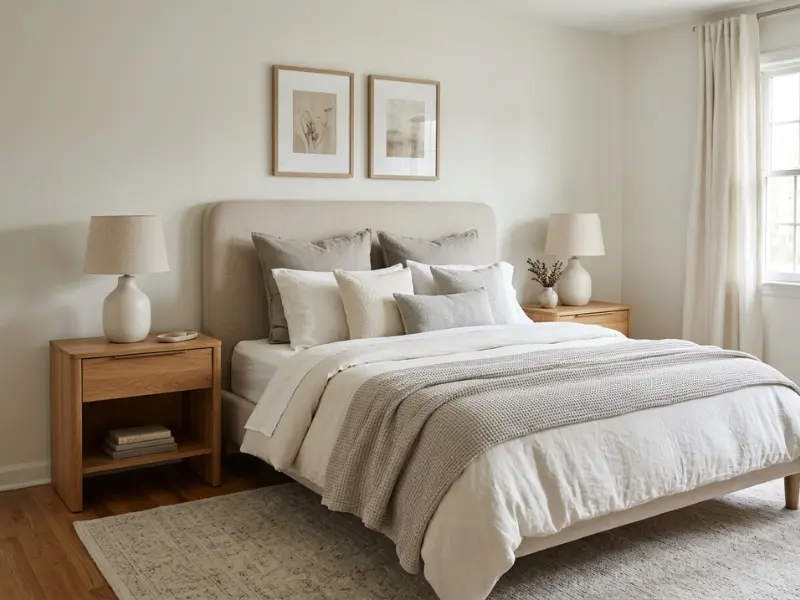
For a transitional bedroom, choose an upholstered headboard in cream or gray. Layer standard and European pillows with a neutral throw for a full, hotel-style bed.
Pair a classic bed with modern nightstands, and add softly curved lamps. Bedding with one soft pop of color keeps it lively.
Kitchen (Cabinet Style, Hardware, Backsplash, Lighting)
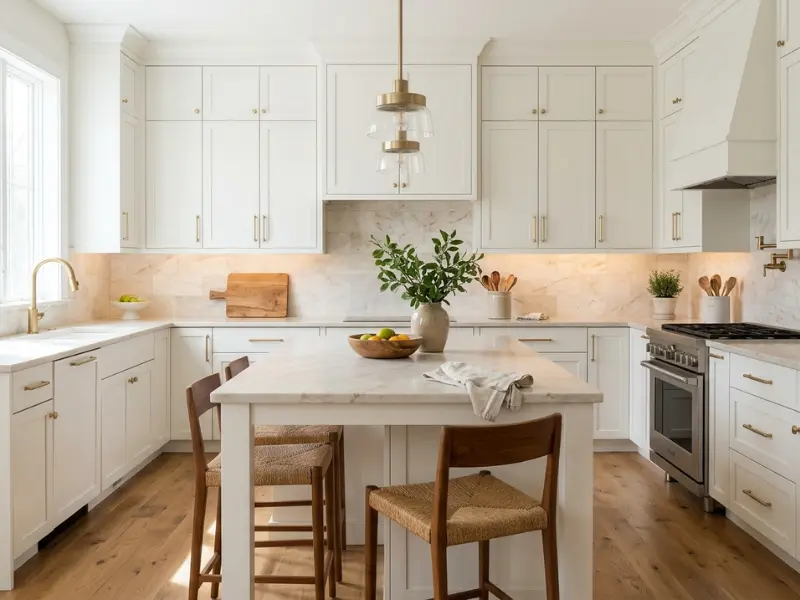
A transitional kitchen leans on four things:
- Cabinets: Shaker-style doors in white or off-white
- Hardware: brass, nickel, or bronze pulls, all in one finish
- Backsplash: marble or simple ceramic tile
- Lighting: plain pendants over your island or table
Let your cabinets be the classic part. Make the pulls, lights, and stools the modern part, since they’re easy to swap. You can update the look later without touching the cabinets.
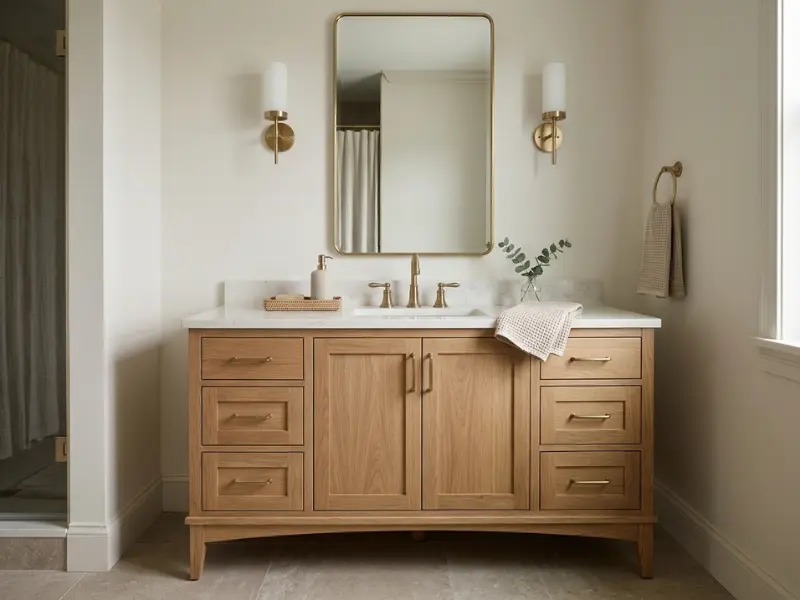
Bathroom
A transitional bathroom comes down to four choices:
- Vanity: furniture-style, with simple lines
- Mirror: a plain frame or a large frameless mirror
- Faucet and sconces: one finish, repeated
- Tile: neutral porcelain or marble-look tile
Repeat your faucet finish on a mirror frame or sconce. That one echo makes the whole room look planned.
Dining Room
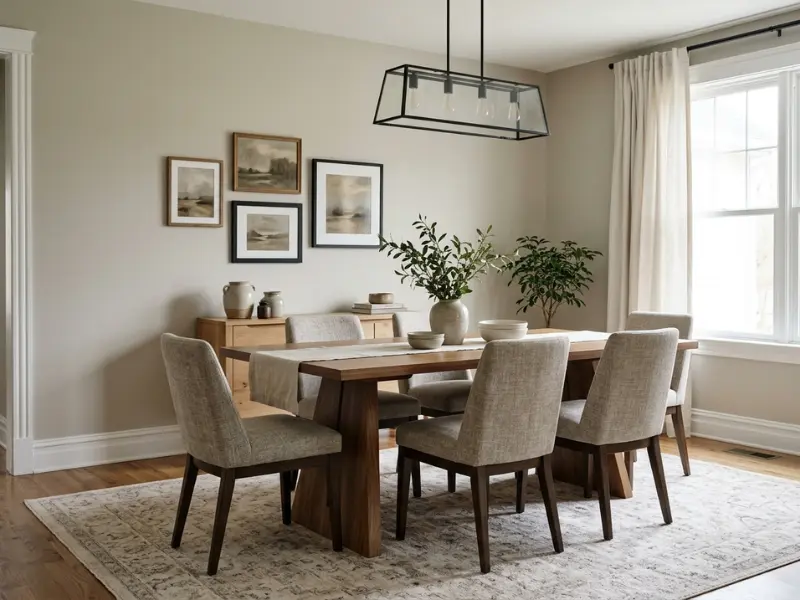
In a transitional dining room, contrast your shapes. A table with an angular base looks great next to cushioned chairs. Add a softly patterned rug and one or two paintings for a hint of color.
Every room needs a starting point. If you’re not sure where yours is, here is a simple step-by-step plan.
How Do You Start Decorating Step by Step?
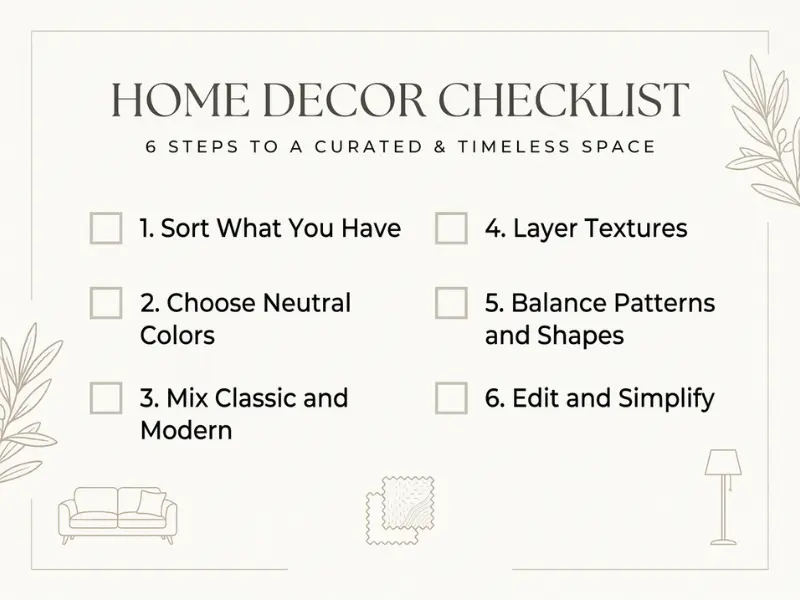
Start with what you already own. Pick a neutral base, keep your best classic pieces, add one or two modern ones, then layer in texture and light.
Six short steps show you how to decorate in transitional style. After them, you’ll get ways to do it on a small budget or in a rental.
Step 1 to 6
- Sort your things. Make three piles: classic, modern, and neither. Now you can see what you have.
- Pick your base neutral. Use cream, greige, or warm white for walls and your biggest pieces.
- Keep one or two classic pieces you love. A wood dresser or a rolled-arm chair works well.
- Add one modern piece to balance them. A metal-leg table or a sleek lamp does the job.
- Layer in soft things. Try a wool throw, linen pillows, and a plain rug.
- Edit last. Take one item off each surface, then step back and look.
Try the old and new check after step 4. Count the old and new pieces in your room. If everything comes from one era, swap one piece.
In an all-new room, bring in a vintage frame or an old wood stool. You don’t need a perfect split. You just need both eras in the room.
How to Do It on a Budget or as a Renter
You don’t need new furniture to start. Small swaps change a room fast.
- Change pillow covers, lamps, and throws first
- Look in thrift shops and online resale for your classic piece
- Add a rug over floors you can’t change
- Use plug-in lamps and floor lamps instead of new ceiling lights
- Bag your old cabinet pulls so you can swap them back
Even with a good plan, a few traps are easy to fall into. Here is how to spot them early.
What Mistakes Should You Avoid?
Going all beige, matching every piece, adding too many bold items, and ignoring room size are the four big ones. Each has a quick fix.
Here is what each mistake looks like, and how to fix it in minutes.
Going All Beige With No Texture
The room looks calm, but it also looks flat. Nothing catches your eye or your hand.
Quick fix: Swap in one wool, wood, or leather piece, like a throw or a stool.
Buying One Matching Set
A matching sofa, loveseat, and chair can make the room look like a showroom. The mix of old and new gets lost.
Quick fix: Replace one piece in the set with something from a different shape or era.
Too Many Statement Pieces
A bold chandelier, a loud rug, and a huge painting all fight for your eye. The room feels busy, not calm.
Quick fix: Choose one hero piece per room. Tone down the rest.
Wrong Scale (Furniture Too Big or Too Small for the Room)
A giant sectional can swallow a small room. Tiny chairs can look lost in a big one.
Quick fix: Measure first, and leave about 3 feet of walking space around your seating. Then tape the sofa’s size on the floor and see how it feels.
Now you know what to do and what to skip. One last question is left: is this style right for you?
Is Transitional Style Right for You, and Is It Still Popular?
Yes, if you like both classic and modern looks, share a home with mixed tastes, or want a look that won’t age fast. Skip it if you love bold, themed rooms.
Here you’ll see who it suits, a short list of pros and cons, and where the style stands in 2026.
Who It Suits (Families, Renters, Mixed Tastes)
- Families who need comfy, easy-care seating
- Couples who like different styles
- Renters who want to keep what they own
- Anyone who can’t pick between old and new
Pros and Cons
Here is the honest picture.
Pros:
- Works with old and new furniture you already own
- Refreshes easily with small swaps
- Fits mixed tastes under one roof
- Doesn’t tie you to one era or trend
Cons:
- Turns flat and beige without texture
- Feels less bold unless you add personality
- Needs a little practice to balance
- Won’t satisfy lovers of strong themes
Is It Still in Style in 2026?
Yes. A 2026 kitchen trends report from the National Kitchen and Bath Association found that 72% of participants picked the transitional kitchen as their favorite design. Design writers also say transitional living rooms are making a comeback in 2026.
The look is shifting a bit, too. Designers now say the style leaves more room for personality and bold mixing. They also say it should suit your home’s architecture, not fight it.
Still curious? Here are quick answers to common questions.
Frequently Asked Questions
What is transitional style decor in simple words?
Transitional style decor is a mix of old and new looks in one calm room. You get classic shapes, like a rolled-arm chair, with simple modern pieces, like a sleek lamp. Soft neutral colors tie them together. The result feels cozy, tidy, and timeless, so it works in almost any home.
What is the difference between transitional and traditional style?
Traditional style is formal, with carved wood, rich colors, and many patterns. Transitional keeps the comfy seating but drops the fuss. You get lighter woods, softer colors, and far fewer patterns. A traditional room feels fancy and full. A transitional room feels relaxed and open, even when it uses classic pieces.
What is the difference between transitional and modern or contemporary style?
Modern style is sleek and bare, while contemporary style follows whatever is popular now. Transitional sits between old and new and adds warmth. Expect clean lines, soft fabrics, and a few curves. It also stays steady over time, because it doesn’t chase trends the way contemporary style does.
What colors are used in transitional style?
Soft neutrals lead: cream, beige, greige, taupe, and warm white. Muted blue, sage, and seafoam add gentle color. Deep tones like navy or emerald work in small doses, such as one vase or chair. Brass and bronze add a soft shine. Most rooms stick to one base neutral and one or two accents.
What furniture is transitional style?
Transitional furniture has simple shapes and a comfy feel. Think a roomy sofa or sectional in linen or velvet, paired with a round side table and a wood coffee table with thin metal legs. Straight lines mix with a few curves. Add one classic piece, like a rolled-arm chair or a vintage dresser, for character.
Is transitional style still in style in 2026?
Yes, transitional style decor is still popular in 2026. A 2026 kitchen survey named the transitional kitchen the top pick, and design writers say transitional living rooms are coming back. Today’s version leaves more room for personality, so you can blend eras boldly.
Is transitional style the same as modern farmhouse?
No. Modern farmhouse leans rustic, with shiplap, barn-style wood, and black metal accents. Transitional has no theme. It uses calm neutrals, smooth lines, and soft finishes. The two can share neutral colors, but farmhouse tells a country story. Transitional rooms don’t tell any story, so they suit city and suburban homes alike.
Can you do transitional style decor on a budget or as a renter?
Yes. Transitional style decor works with pieces you already own, so you can start small. Swap pillow covers, add a wool throw, and put a rug over floors you can’t change. Renters can bag their original cabinet pulls, install new ones, and swap back at move-out.
How do you mix old and new furniture without it looking messy?
Tie them together with one shared link: a color, wood tone, or metal finish. For example, match an antique chair’s wood to a new picture frame. Keep your big pieces simple, and limit bold items to one per room. If everything looks old or new, swap one piece.
Conclusion
What is transitional style decor? It is balance. A neutral base keeps things calm, texture keeps them interesting, and a mix of old and new keeps the room from feeling like a showroom.
You don’t have to do it all in one weekend. Pick one room, and start there. Sort your pieces into classic and modern, then run the old and new check. If everything comes from one era, swap one piece.
Next, add something soft, like a wool throw or linen pillows, and take one item off each surface. Then step back and look. That alone can change how a room feels.
Try it this week with the room you use most, even if you only have an hour. Set a timer, make one swap, and see how it feels.
If a piece feels off, swap it and look again. Small changes are easy to undo, so you can keep adjusting your transitional style decor as you go.